
Scar Camouflage in Dubai: Does It Work for Scars and Stretch Marks?
Scar camouflage, also known as paramedical tattooing or medical micropigmentation, is a specialized treatment used to reduce the visible contrast between scar tissue and the surrounding natural skin color.
It does not erase a scar. It does not rebuild damaged skin. But when performed on the right type of scar, using the correct pigment, technique, and clinical safety standards, it can make scars and stretch marks look significantly less visible.
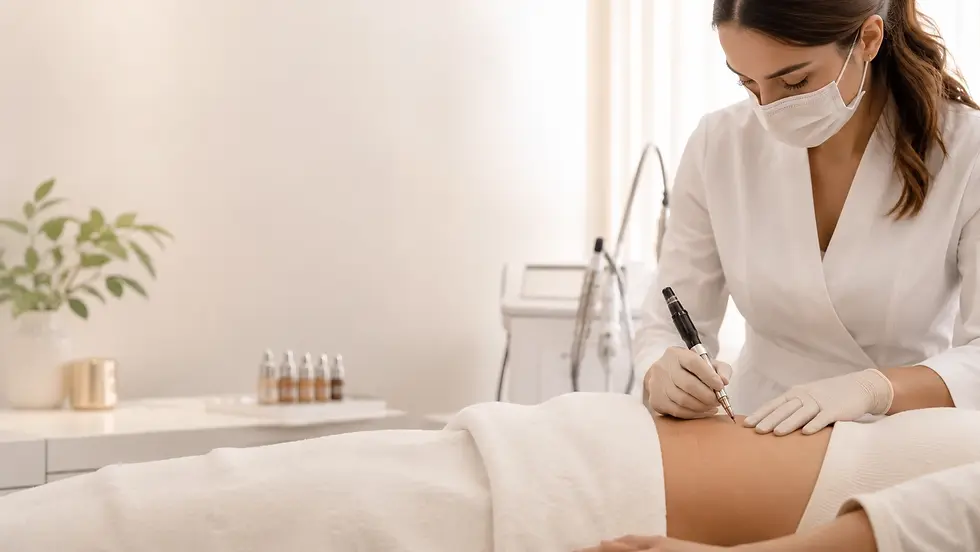
At Huzz Ink Clinic Emirates Hills, scar camouflage is treated as a clinical paramedical tattoo procedure, not simple cosmetic tattooing. Every case requires scar assessment, skin-tone analysis, pigment planning, hygiene control, and realistic expectations before treatment begins.
Quick Answer
Scar camouflage can work very well for selected scars and stretch marks.
The best results are usually seen on:
Flat white scars
Mature surgical scars
Pale trauma scars
Hypopigmented scars
Stable burn scars
Some acne scars
Old white stretch marks
The weakest results are usually seen on:
Keloid scars
Raised hypertrophic scars
Red or inflamed scars
New scars
Deep textured stretch marks
Sun-exposed visible areas
Scars that are still changing
For stretch marks, skin-tone pigment can improve the color difference, but it cannot remove texture, indentation, or wrinkled skin. In many cases, the best result comes from improving the texture first with CO₂ fractional laser or microneedling, then applying camouflage pigment only if needed.
What Is Scar Camouflage?
Scar camouflage is a form of paramedical tattooing where carefully matched pigment is implanted into scar tissue to blend the scar with the surrounding skin.
The goal is not to make the scar disappear completely. The goal is to make it less noticeable by reducing the color difference.
Scar camouflage can help with scars that appear:
White
Pale
Lighter than surrounding skin
Uneven in color
Visibly different after healing
When done correctly, it creates a smoother visual transition between scar tissue and normal skin.
How Successful Is Scar Camouflage?
Published medical reports show high patient satisfaction for medical tattooing and scar camouflage, often around 70–90% or more in suitable cases.
This does not mean every scar improves by 90%. It means most well-selected patients report that the scar looks better, blends better, and causes less cosmetic concern after treatment.
The highest success is usually seen when the scar is:
Fully healed
Flat
Stable
Pale or white
Not raised
Not inflamed
Not keloid-prone
At least 12–18 months old
Scar tissue does not always hold pigment like normal skin, so multiple sessions or retouches may be needed.
Does Scar Camouflage Completely Hide a Scar?
No. Scar camouflage improves the color, not the structure of the scar.
A scar may still be visible because of:
Texture
Shine
Indentation
Raised tissue
Skin tightness
Shadowing
Different light reflection
This is why honest consultation is important.
If the scar has a texture problem, pigment alone may not be enough. In those cases, the

best approach is usually:
Texture correction first → pigment camouflage second
At Huzz Ink Clinic, this may include assessment for CO₂ fractional laser, microneedling, or other skin-texture treatments before applying pigment.
Is Skin-Color Ink a Good Method for Covering Scars?
Yes, skin-color pigment can be a good method, but only when it is used correctly.
Skin is not one flat color. It changes with undertone, blood flow, melanin, sun exposure, and lighting. Scar tissue also behaves differently from normal skin.
Proper scar camouflage requires:
Skin-tone analysis
Scar color analysis
Undertone matching
Conservative pigment selection
Layered application
Controlled needle depth
Sterile single-use equipment
Follow-up after healing
Retouch if needed
Using the wrong “skin color” can make the scar look worse.
Possible problems from poor pigment matching include:
Pigment looking too dark
Pigment looking too yellow
Pigment looking too pink
Pigment turning grey or ashy
Visible border around the scar
Artificial painted appearance
Color mismatch after tanning
This is why scar camouflage should be performed by someone who understands both tattoo pigment and skin healing.
Why We Do Not Recommend Scar Camouflage on Sun-Exposed Visible Areas
At Huzz Ink Clinic, we usually do not recommend scar camouflage for highly visible areas that are regularly exposed to the sun, unless the case is carefully selected and the client fully understands the limitations.
The reason is simple: natural skin changes color, but tattoo pigment does not change in the same way.
When natural skin tans or darkens from UV exposure, the implanted pigment may stay the same. This can make the camouflage look mismatched over time.
Sun exposure can also cause:
Faster pigment fading
Pigment color shift
Uneven healing
More visible contrast
Hyperpigmentation around the treated area
Darkening or lightening of surrounding skin
A result that looks good indoors but different outdoors
For this reason, scar camouflage is usually more predictable in areas that are not constantly exposed to sunlight.
Higher-risk visible or sun-exposed areas include:
Face
Neck
Hands
Forearms
Shoulders
Upper chest
Lower legs, depending on lifestyle
For exposed areas, we may recommend other treatments first, such as CO₂ fractional laser, microneedling, medical scar management, or temporary camouflage options, depending on the case.
Can Stretch Marks Be Covered With Skin-Color Ink?
Yes, but with limitations.
Stretch marks are a type of atrophic scar. They are not only a color problem. They are also a structural skin problem.
Stretch marks may be:
White
Pink
Purple
Red
Thin
Shiny
Wrinkled
Depressed
Texturally different from normal skin
Skin-tone pigment can help white stretch marks blend better with surrounding skin, but it does not repair the damaged dermis.
This means the color can improve, but the texture may still be visible.
Best Treatment Method for Stretch Marks
For stretch marks, the strongest clinical approach is usually a combination plan.
Step 1: Improve the Texture
This may include:
CO₂ fractional laser
Microneedling
Collagen stimulation
Skin resurfacing
Step 2: Allow Proper Healing
The skin must settle before pigment is added.
Step 3: Apply Camouflage Pigment Only If Needed
Once the texture and color are stable, skin-tone pigment can be used to reduce the remaining contrast.
This gives a more complete and professional result than pigment alone.
CO₂ Fractional Laser for Scars and Stretch Marks
CO₂ fractional laser is used to improve skin texture by creating controlled micro-injuries in the skin. This stimulates collagen remodeling and can help improve the appearance of scars, stretch marks, and uneven skin texture.
CO₂ fractional laser may help with:
Acne scars
Surgical scars
Burn scars
Stretch marks
Uneven scar texture
Thick or rough scar surface
Skin resurfacing
Collagen stimulation
CO₂ laser does not erase a scar, but it can improve texture, soften the skin, and make the area more suitable for camouflage if pigment is needed later.
For many scars and stretch marks, this is the better first step before tattoo camouflage.
Microneedling for Scars and Stretch Marks
Microneedling is another treatment used to stimulate collagen and improve skin texture.
It creates controlled microchannels in the skin, encouraging natural repair and remodeling.
Microneedling may help with:
Mild acne scars
Fine stretch marks
Shallow atrophic scars
Skin texture irregularity
Collagen stimulation
Mild scar softening
Microneedling is usually less aggressive than CO₂ fractional laser, but it may require more sessions depending on scar depth and skin response.
For stretch marks, microneedling can be useful before considering camouflage pigment.
Scar Camouflage vs CO₂ Laser vs Microneedling
Scar camouflage improves color.
CO₂ fractional laser improves texture and resurfacing.
Microneedling improves collagen stimulation and mild texture irregularity.
The best treatment depends on the main problem:
Concern
Best Option
White or pale flat scar
Scar camouflage
Uneven texture
CO₂ fractional laser or microneedling
Deep stretch marks
CO₂ fractional laser first
Mild stretch marks
Microneedling or CO₂ laser
Raised scar
Medical scar treatment first
Keloid scar
Not suitable for camouflage
Sun-exposed visible area
Usually not recommended for pigment
Color + texture problem
Combination treatment
Best Candidates for Scar Camouflage
Scar camouflage works best for clients with:
Flat scars
White scars
Old surgical scars
Pale trauma scars
Stable burn scars
Healed acne scars
Mature stretch marks
Realistic expectations
Areas not heavily exposed to sun
The scar should usually be fully healed for at least 12–18 months before camouflage. This allows the scar to mature and stop changing in color, thickness, and texture.
Poor Candidates for Scar Camouflage
Scar camouflage may not be suitable for:
Keloid scars
Active hypertrophic scars
Raised scars
Red scars
Itchy scars
Painful scars
New scars
Inflamed skin
Open wounds
Sun-exposed visible areas
Unstable pigmentation
Strong keloid history
Unrealistic expectations
Keloid and raised scars should usually be treated medically first before any pigment is considered.
Tattooing unstable scar tissue can create more irritation, poor pigment retention, or worse scarring.
Scar Camouflage for Surgical Scars
Surgical scars are often good candidates if they are flat and mature.
Common examples include:
C-section scars
Breast surgery scars
Cosmetic surgery scars
Orthopedic surgery scars
Trauma repair scars
Small operation scars
The result depends on scar width, color, texture, location, and how the skin healed after surgery.
If the surgical scar is raised, red, or thick, CO₂ fractional laser or another scar treatment may be recommended before camouflage.
Scar Camouflage for Burn Scars
Burn scars can improve with camouflage if the scar is fully healed, stable, and not actively inflamed.
Burn scars often have both color and texture irregularities, so they may need a combined treatment plan.
For some burn scars, pigment camouflage can improve the pale or patchy color. For thicker or textured burn scars, CO₂ fractional laser may be recommended first.
Scar Camouflage for Acne Scars
Acne scars are usually texture-based scars, not only color-based scars.
If acne scars are depressed or uneven, pigment alone may not create the best result. Texture treatments such as CO₂ fractional laser or microneedling may be more important before considering camouflage.
Pigment may help only when there is a clear color mismatch after the texture has improved.

How Many Sessions Are Needed?
Most scar camouflage cases require more than one visit.
Typical plan:
Consultation and scar assessment
First camouflage session
Healing period
Second session or retouch after 4–8 weeks
Additional session if needed
Most clients need 2–3 sessions for a proper blended result.
Larger scars, stretch marks, burn scars, or uneven scar tissue may need more sessions.
CO₂ fractional laser and microneedling also usually require multiple sessions depending on scar depth and skin response.
How Long Does Scar Camouflage Last?
Scar camouflage is semi-permanent.
The pigment can last for several years, but it may slowly fade over time.
Longevity depends on:
Skin type
Scar tissue quality
Pigment retention
Sun exposure
Lifestyle
Aftercare
Body area
Immune response
Touch-ups may be needed every 1–3 years depending on the case.
Sun exposure can fade pigment faster and cause color mismatch, so healed areas should be protected with sunscreen.
Is Scar Camouflage Safe?
Scar camouflage can be safe when performed in a licensed clinical setting with proper hygiene, correct patient selection, and sterile technique.
Possible risks include:
Infection
Pigment mismatch
Pigment fading
Uneven healing
Allergic reaction
Hyperpigmentation
Hypopigmentation
Granuloma
Scarring
Keloid reaction
Need for correction or removal
The biggest risks come from poor hygiene, wrong pigment choice, wrong needle depth, and treating scars that are not ready.
At Huzz Ink Clinic, every procedure is performed using strict hygiene standards, single-use disposable equipment, and personalized aftercare guidance.

Starting Prices at Huzz Ink Clinic Dubai
Pricing depends on scar size, scar type, skin condition, treatment area, and whether texture treatment is needed before camouflage.
Scar camouflage: starting from 800 AED
Stretch mark camouflage: starting from 1,500 AED
CO₂ fractional laser: starting from 800 AED per session
Microneedling: starting from 500 AED per session
Combination treatment plans: starting from 1,800 AED
Final pricing is confirmed after consultation because scars and stretch marks differ in depth, texture, color, and healing response.
What Affects the Price?
The final price depends on:
Scar size
Scar type
Skin tone
Body area
Texture condition
Whether the area is sun-exposed
Whether CO₂ laser is needed first
Whether microneedling is needed first
Whether multiple pigment layers are needed
Whether the case is scar camouflage or stretch mark camouflage
Number of sessions required
A consultation is recommended before confirming the treatment plan.
Why Cheap Scar Camouflage Can Be Risky
Scar camouflage is not the same as normal tattooing.
A cheap treatment can become expensive if the pigment heals badly or the scar becomes more visible.
Common problems from poor work include:
Wrong skin color
Grey or orange pigment
Patchy healing
Pigment migration
Overworked scar tissue
Infection
New scarring
Artificial-looking results
Color mismatch after sun exposure
Scar camouflage should be done carefully, slowly, and only on the right candidate.
Why Huzz Ink Clinic Is Different
Huzz Ink Clinic combines tattoo expertise with clinical safety.
This matters because scar camouflage requires understanding both:
How tattoo pigment behaves inside the skin
How scar tissue heals and reacts
At Huzz Ink Clinic Emirates Hills, the approach includes:
DHA-licensed clinical environment
Professional scar assessment
Skin-tone and undertone evaluation
Single-use disposable equipment
Careful pigment matching
Experience with tattoo ink behavior
CO₂ fractional laser support when suitable
Microneedling support when suitable
Personalized aftercare
Realistic treatment planning
The goal is not to promise that scars will disappear. The goal is to choose the correct method for each case and improve the appearance safely.
Frequently Asked Questions
Does scar camouflage really work?
Yes, scar camouflage can work very well for flat, mature, pale scars. It reduces the color difference between the scar and surrounding skin, making the scar less noticeable.
Can scar camouflage remove a scar?
No. Scar camouflage does not remove scar tissue. It improves the color match. Texture, indentation, shine, or raised tissue may still be visible.
Can stretch marks be tattooed with skin-color ink?
Yes. Old white stretch marks can sometimes be camouflaged with skin-tone pigment. However, the ink only improves color. It does not repair the texture of the stretch mark.
What is better for stretch marks, CO₂ laser, microneedling, or camouflage?
For many stretch marks, CO₂ fractional laser or microneedling should be done first to improve texture. Camouflage pigment can then be used later to improve color blending.
Why is scar camouflage not recommended for sun-exposed areas?
Because natural skin changes color with sun exposure, but tattoo pigment does not change the same way. This can create color mismatch, faster fading, or a visible difference between the treated scar and surrounding skin.
How many sessions are needed for scar camouflage?
Most clients need 2–3 sessions. Some small scars may need fewer sessions, while larger scars or stretch marks may need more.
Is scar camouflage painful?
Discomfort is usually mild to moderate. Numbing may be used when suitable. Most clients describe the feeling as scratching, vibration, or light tattoo discomfort.
Can keloid scars be camouflaged?
Keloid scars are usually not suitable for camouflage tattooing unless medically treated and cleared first. Tattooing a keloid-prone area can trigger more scar growth.
How long should I wait before scar camouflage?
Most scars should be fully healed and stable for 12–18 months before camouflage. New scars can continue changing, so tattooing too early can lead to poor results.
How much does scar camouflage cost in Dubai?
At Huzz Ink Clinic, scar camouflage starts from 800 AED. Final pricing depends on the scar size, texture, color, and number of sessions needed.
How much does stretch mark camouflage cost in Dubai?
Stretch mark camouflage starts from 1,500 AED. Some cases may need CO₂ fractional laser or microneedling before pigment camouflage.
How much does CO₂ fractional laser cost in Dubai?
CO₂ fractional laser starts from 800 AED per session. It may be recommended before camouflage when the scar or stretch mark has texture, indentation, or roughness.
How much does microneedling cost in Dubai?
Microneedling starts from 500 AED per session. It may help with mild scars, fine stretch marks, and collagen stimulation before camouflage.
Book a Scar Camouflage Consultation in Dubai
Scar camouflage can be a powerful solution for the right scar, but it must be planned correctly.
Before treatment, the scar needs to be assessed for:
Age
Color
Thickness
Texture
Skin tone
Sun exposure
Keloid risk
Pigment suitability
Need for CO₂ laser first
Need for microneedling first
Book a consultation at Huzz Ink Clinic Emirates Hills to understand whether your scar or stretch marks are suitable for camouflage and what result is realistic for your skin.

About Huzz Ink Clinic Dubai
Huzz Ink Clinic Emirates Hills is a DHA-licensed tattoo, laser, and aesthetic clinic in Dubai.
The clinic provides:
Scar camouflage
Stretch mark camouflage
Burn scar camouflage
Paramedical tattooing
Laser tattoo removal
CO₂ fractional laser treatments
Microneedling
Scalp micropigmentation
Artistic tattooing
Piercing
Huzz Ink Clinic follows fully disposable, single-use safety standards and provides personalized aftercare for every client.


